



Y2 Class Interference Suppression Capacitors Meet 2,000-Hour 85/85 THB Tests, AEC-Q200
Type MYH series of Y2, EMI/RFI suppression capacitors are designed for harsh environments. The MYH series is AEC-Q200 qualified, meets a 2,000-hour THB (Temperature, Humidity, Bias) life test, and has applications in motors, AMR (Automated Meter Readers), UPS, power supplies, charging systems, and appliances. These Y2, line-to-ground capacitors filter out electromagnetic noise and have multiple international safety agency approvals.
The 2,000-hour THB test conducted at 85 °C, 85% relative humidity at rated voltage, subjected these components to twice the industry standard test hours required to meet IEC 60834, Class III-B for THB.
The MYH capacitor series also passed the rigors of AEC-Q200 automotive testing. These tests include mechanical shock and vibration, thermal cycling, solvent resistance and solderability which qualify the series for use in the most demanding industrial, automotive, and consumer applications.
Capacitance values range from 0.001 to 1 µF in 29 standard values, at 300 Vac, 50/60Hz. Their operating temperature range is from -40° C to +110° C. The series possesses multiple agency approvals including UL, CSA, VDE, for safety and performance in Y2, line-to-ground applications.
- Excels at EMI Suppression in harsh environmental conditions
- THB 2,000 Hr @ 85 ºC, 85% RH, and Vr
- Automotive Grade (AEC-Q200) qualified
- High operating temperature: up to 110 °C
- International agency approvals for safety and performance
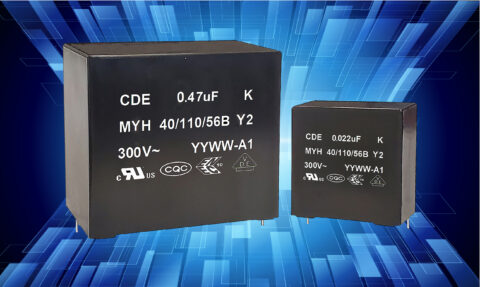
Applications Include:
Class Y2 EMI/RFI Line-to-Ground Filters for Harsh Environments, Utility Meters, UPS, EV Chargers, Inverters, SMPS, and Portable Power Systems
Find a Rep Find a Distributor
New Products
-

Released Aug, 2024
Type QAS, Arc Suppressor/Snubber Network
Type QAS will extend the operating life of electronic and electro-mechanical devices by reducing and/or eliminating the electrical arcing, noise, and EMF. These electrical conditions often cause early failures in relays, switch contacts, and solid-state components such as SCRs and TRIACs.
-
Released Mar, 2024
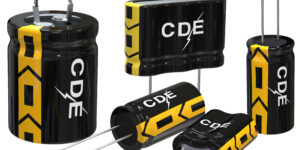
3 CELL DSF & DGH
Three-cell devices offer greater energy potential and power output than single or dual-cell parts in standard PCB layouts
3-cell DSF & DGH capacitors provide very fast power discharge that cannot be matched by conventional capacitors or batteries. That large capacity makes it possible to support brief power interruptions, supplement batteries, or even be used in place of batteries in many applications.
-
Released Nov, 2023
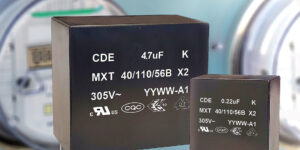
TYPE MXT, X2, EMI/RFI Suppression Capacitors, Harsh Environment
Type MXT Series Metallized Polypropylene Film Capacitor, designed to suppress conducted electromagnetic/radio frequency interference (EMI/RFI) at a circuit’s power input. These capacitors are perfect for use in harsh environments having met the demanding 85/85 THB (Temperature, Humidity, Bias) test requirements. Class X2 capacitors, like the MXT, are typically connected across the AC input to prevent interference from spreading through power lines or other devices on the same circuit.