



Energy Dense, Very Low-Profile Capacitors Now 5,000 hr. Rated
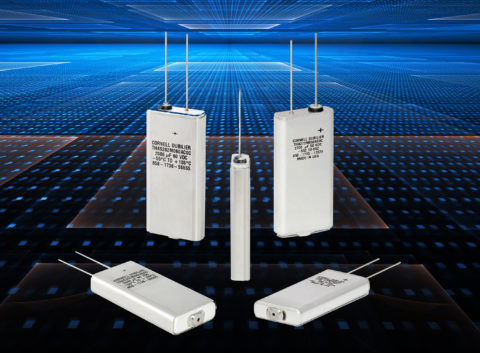
THA and THAS Series Thinpack aluminum electrolytic capacitors deliver the highest-energy density in a low-profile.
First introduced in 2018, Cornell Dubilier (CDE) has made significant design tweaks to their groundbreaking THA and THAS Series Thinpack capacitors. The product updates raise the rated life to 5,000 hours, a 66% increase over the first-generation devices. The key strength of the series is still high energy density. The 85 ºC THA Series Thinpack capacitors are only 8.2mm thick, and 9mm for the 105 ºC THAS Series. While of similar height to V-chip electrolytics, tantalums, and board-mounted axials, THA and THAS offer much higher bulk-storage capability. For example, a single THA/THAS capacitor can replace an entire board full of SMT, axial or radial aluminum electrolytic or solid tantalum capacitance arrays. The upgrade to a 5,000-hour rating expands the potential range of applications to longer life commercial and MIL/Aero devices. All THA/THAS capacitors sold after January 1, 2020, will meet the new performance specifications. Pricing is unchanged.
THA/THAS Series capacitors are thinner and more cost-effective than most alternative technologies. Unlike traditional cylindrical electrolytics, THA/THAS capacitors have sealed, laser-welded aluminum cases to eliminate the need for space-wasting end seal gaskets. Compared to cylindricals, flat THA and THAS capacitors are up to 60% smaller by volume. The design includes a valve to vent hydrogen gas buildups that may otherwise cause pressure-related swelling. The 105°C rated THAS Series adds a 0.38mm form-fitting stainless-steel sleeve to further prevent swelling at the highest temperatures.
Compared to a bank of SMT or axial aluminum electrolytic capacitors comprising similar total values, THA/THAS capacitors can offer significant cost, weight, and space savings. The benefits include requiring about 70% less board space than alternatives. Even where size or weight reduction is not essential, the smaller part and connection count improves overall circuit reliability (one part vs. many). The THA is rated at 5,000 hr. life @ 85°C; and the THAS is rated at 5,000 hr. life @ 105°C. Values range from 140 µF at 450 Vdc to 18,000 µF at 10 Vdc, with 72 capacitance/voltage combinations available for each series.
Potential applications include any circuits that require high capacitance bulk storage and filtering. These include: tablets, laptops, instrumentation, commercial-grade LED driver modules, compact power supplies, drones and RPVs, set-top boxes, 1U rack-mounted devices, and other high-performance, low-profile devices.
Highlights
- THA Thin profile, 8.2 mm thin
- THAS Thin profile, 9 mm thin
- Very high energy density
- THA 5000 hr life @ 85 ºC
- THAS 5000 hr life @ 105 ºC
- REACH and RoHS Compliant
Parametric Search THAS
Presentation: THA and THAS, Thinpack, Aluminum Electrolytic Capacitors
Aluminum Electrolytic Capacitor Redesign Saves Space
(As seen in September 2017 Electronic Products Magazine.)
Applications Include:
Tablets, laptops, specialized instruments, LED driver modules, compact power supplies, drones and RPV's, set-top boxes, narrow, 1U rack-mounted devices, video monitors, solid state drives, displays and security systems.
Find a Rep Find a Distributor
New Products
-

Released Aug, 2024
Type QAS, Arc Suppressor/Snubber Network
Type QAS will extend the operating life of electronic and electro-mechanical devices by reducing and/or eliminating the electrical arcing, noise, and EMF. These electrical conditions often cause early failures in relays, switch contacts, and solid-state components such as SCRs and TRIACs.
-
Released Mar, 2024
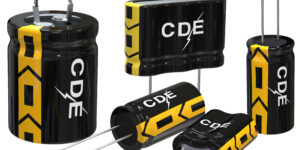
3 CELL DSF & DGH
Three-cell devices offer greater energy potential and power output than single or dual-cell parts in standard PCB layouts
3-cell DSF & DGH capacitors provide very fast power discharge that cannot be matched by conventional capacitors or batteries. That large capacity makes it possible to support brief power interruptions, supplement batteries, or even be used in place of batteries in many applications.
-
Released Nov, 2023
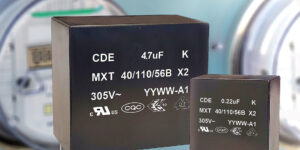
TYPE MXT, X2, EMI/RFI Suppression Capacitors, Harsh Environment
Type MXT Series Metallized Polypropylene Film Capacitor, designed to suppress conducted electromagnetic/radio frequency interference (EMI/RFI) at a circuit’s power input. These capacitors are perfect for use in harsh environments having met the demanding 85/85 THB (Temperature, Humidity, Bias) test requirements. Class X2 capacitors, like the MXT, are typically connected across the AC input to prevent interference from spreading through power lines or other devices on the same circuit.